
Are You Ready for Lightning Season or Waiting for Your Fire Alarm System to Fail?
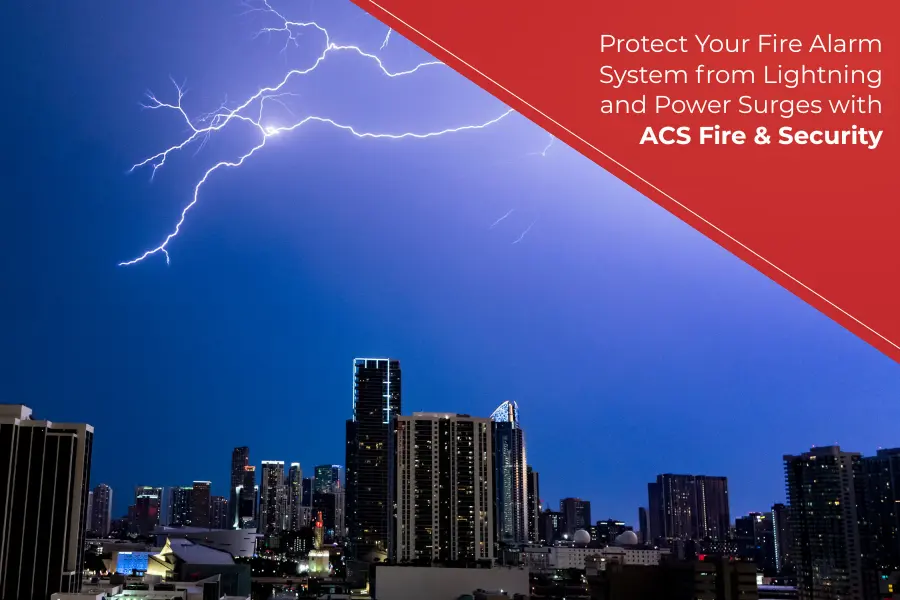
In Central Florida, power surges don’t just disrupt operations, they can disable your fire alarm system at the exact moment it is needed most.
Florida leads the country in lightning strikes, and businesses across Orlando and the surrounding areas experience the impact every year. Systems fail without warning, communication paths are disrupted, and panels can go offline during storms, often when protection is critical.
At ACS Fire & Security, we regularly work with businesses that only discover their system’s vulnerability after a surge event has already caused damage, which raises a more important question: is your system prepared before lightning season begins?
Most Damage Doesn’t Come From Direct Strikes
A common assumption is that lightning must strike your building directly to cause damage, but most failures are the result of nearby activity and electrical fluctuations that move through connected infrastructure.
These conditions typically include:
- Nearby lightning strikes
- Utility grid fluctuations
- Voltage traveling through building wiring
- Surges entering through communication lines or between connected buildings
When these events occur, the impact is not always immediate or obvious. Systems may continue to appear functional while underlying damage begins to affect performance, which can lead to panel issues, communication failures, or intermittent problems that are difficult to diagnose until they escalate.
If your system has not been evaluated for surge exposure recently, call (407) 270-2749 or schedule your free consultation to review your current protection strategy.
Why Surge Protection Is Critical in Florida
In a high-lightning environment like Central Florida, surge protection is not an upgrade, it is part of maintaining a reliable fire alarm system.
ACS installs surge protection at critical points throughout the system, including power entry, communication pathways, and signaling circuits, with the goal of reducing the impact of voltage spikes before they reach sensitive equipment.
Proper installation matters just as much as the devices themselves. Surge protection must be placed and configured according to manufacturer specifications, with careful attention to grounding, separation, and overall system design. Without that level of precision, protection may not function as intended.
Installation Determines Whether Protection Works
Surge protection is only effective when it is engineered into the system correctly, which means installation plays a direct role in how well it performs over time.
Improper installation can reduce effectiveness, leave key components exposed, or create a false sense of security. That is why ACS follows strict installation standards that account for grounding, placement, and integration with the broader system.
This is not an add-on, it is part of how the system is built.
Risk Reduction, Not Elimination
It is important to understand that surge protection reduces risk, it does not eliminate it entirely.
Severe events, direct strikes, or unprotected pathways can still result in system impact, but without protection in place, your system is far more exposed to failure, downtime, and costly repairs.
The goal is to improve system resilience and reduce the likelihood of major disruption, not to assume that risk can be completely removed.
The Cost of Surge Damage Goes Beyond Equipment
When a surge affects a fire alarm system, the impact extends beyond replacing damaged components and often introduces operational challenges that affect the business as a whole.
Businesses commonly experience:
- Emergency service calls
- Operational disruption
- Failed inspections
- Insurance complications
- Increased liability exposure
For multi-building properties or networked systems, a single event can affect multiple areas at once, which increases both cost and complexity. Preventative planning provides a more controlled outcome than reacting after damage has occurred.
Why Inspections Still Matter
Not all surge-related issues appear immediately, and some develop gradually as system performance begins to degrade over time.
Quarterly inspections create a structured opportunity to identify early signs of these issues and confirm that the system continues to operate as intended. During each visit, devices are evaluated under real conditions, and developing problems can be addressed before they become larger failures.
If deficiencies are identified and approved, many can be resolved during the same visit, which helps reduce downtime and maintain inspection readiness.
Built for Central Florida Conditions
Fire alarm systems are not one-size-fits-all, and systems designed for general conditions do not always account for the realities of Florida weather.
ACS designs and supports systems specifically for Central Florida environments, where lightning activity and power fluctuations are part of normal operations. With local experience, structured service scheduling, and one of the lowest technician-to-customer ratios in the region, support remains consistent and responsive.
For more than 20 years, ACS has worked with local businesses to maintain system performance in conditions that demand more than standard installation.
Don’t Wait for the First Storm
Once lightning season begins, any unaddressed vulnerability becomes a real-time risk.
Evaluating your system before the season starts allows you to identify gaps, implement protection, and avoid unexpected failures when conditions are at their worst.
Call (407) 270-2749 or schedule your free consultation to have your fire alarm system reviewed and prepared for the season ahead.

- Planning a Commercial Renovation? Bring Your Fire Alarm Company In Early - October 13, 2026
- Who Still Has Access? Why Security Permissions Need a Periodic Review - October 13, 2026
- Your Fire Alarm Passed Inspection. What Happens Between Now and the Next One? - September 9, 2026